
What Is a Riad in Morocco? Complete Guide to Moroccan Riads
What is a riad in Morocco? A riad is a traditional Moroccan
house or residence built around a private interior courtyard, often featuring
a garden, fountain, decorative tilework, carved wood, plasterwork and a
peaceful atmosphere. Today, many historic riads have been carefully restored
and transformed into beautiful guesthouses, boutique hotels and luxury
accommodations in Morocco’s ancient medinas.
If you are planning a trip to Morocco, you have probably seen the word
riad while searching for accommodation. Travelers often ask,
“What is a riad?”, “What does riad mean in Morocco?” and
“Is staying in a riad better than staying in a hotel?”
The answer is more interesting than simply saying that a riad is a hotel.
A traditional Moroccan riad is an architectural style,
a home and a reflection of Moroccan culture. Modern riads used for tourism
combine this traditional architecture with the comfort travelers expect from
a boutique hotel.
For visitors, staying in a riad can be one of the most memorable parts of a
Morocco vacation. Instead of staying in a large international hotel, you may
sleep inside an old medina building, walk through a quiet doorway from a busy
street and discover a beautiful courtyard hidden inside.
This guide explains everything you need to know about riads in Morocco,
including their meaning, history, architecture, courtyards, decoration,
food, rooftop terraces, differences between riads and hotels, the best cities
for riad accommodation, and practical tips for choosing the right place to
stay.
What Is a Riad in Morocco?
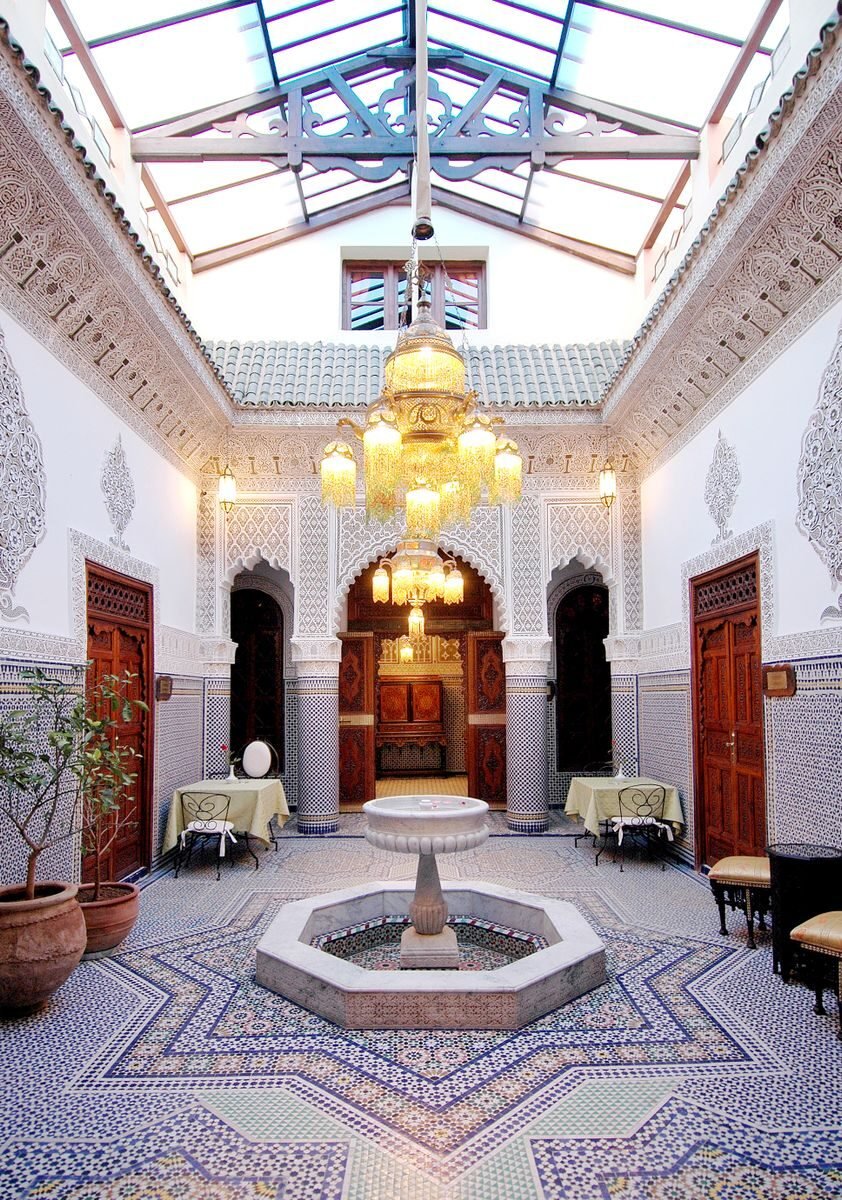
A riad in Morocco is traditionally a private residence
organized around an interior courtyard or garden. The design places the
courtyard at the heart of the house, with rooms arranged around it.
Unlike many modern homes that open toward the street, traditional Moroccan
architecture often turns inward. The outside façade can appear simple,
while the interior reveals elaborate decoration, geometric tilework,
painted ceilings, carved wooden doors and a peaceful courtyard.
Today, the word riad is commonly used by travelers to
describe a traditional Moroccan guesthouse or boutique hotel, particularly
inside historic medinas.
A stay in a riad therefore gives visitors more than a bed for the night.
It can provide an opportunity to experience Moroccan architecture,
hospitality, food and everyday life in a historic neighborhood.
In simple terms:
A riad is a traditional Moroccan home built around an interior courtyard,
often restored and converted into a guesthouse or boutique hotel for
travelers.
What Does Riad Mean?
The word riad is commonly associated with the Arabic word
for garden. In Moroccan architecture, the idea of an interior garden or
courtyard is central to the traditional design.
The courtyard provides light, air and a private outdoor space inside the
building. Depending on the property, it may contain plants, trees, a
fountain, a small pool or traditional Moroccan seating.
This inward-facing design is one reason that a riad can feel surprisingly
quiet even when it is located in the middle of a busy Moroccan medina.
For modern travelers, the phrase Moroccan riad usually
means a traditional-style property offering rooms or suites around a
central courtyard.
The History of Moroccan Riads
Morocco has a long architectural tradition influenced by Amazigh, Arab,
Andalusian, Islamic and Mediterranean cultures. The traditional riad
developed within this broader architectural history as a private and
inward-looking form of urban residence.
Historic Moroccan cities such as Marrakech and Fes contain extensive
medinas with traditional houses, palaces, residences, mosques, fountains,
souks and other buildings.
The UNESCO World Heritage Centre recognizes
the Medina of Marrakech as a historic urban area containing houses, souks,
traditional trades and important architectural monuments.
The Medina of Fes is also internationally recognized for its historic
urban fabric and architecture. UNESCO describes Fes as a city whose medina
preserves residences, palaces, fountains, religious buildings and traditional
architectural knowledge.
As tourism developed, many old Moroccan residences were restored and
converted into guesthouses. These properties allow international visitors
to experience traditional architecture while enjoying modern accommodation.
Traditional Riad Architecture
One of the most fascinating things about a Moroccan riad is its architecture.
The design is usually organized around the central courtyard rather than
around a large exterior façade.
1. Central Courtyard
The courtyard is normally the visual and social heart of the property.
It can include plants, a fountain, tiled floors, traditional seating and
decorative arches.
2. Interior-Facing Rooms
Guest rooms generally face toward the courtyard. This creates a private
atmosphere and separates the interior of the home from the noise of the
street.
3. Zellige Tilework
One of the most recognizable elements of Moroccan design is
zellige, a traditional form of geometric mosaic tilework.
You may see zellige on walls, fountains, floors, stairs and decorative
features.
4. Tadelakt Plaster
Tadelakt is a traditional Moroccan lime-based plaster known for its smooth
appearance. It is often found in bathrooms, walls and other areas of
traditional Moroccan buildings.
5. Carved Wood
Cedar and other types of wood may be used for doors, ceilings, balconies
and decorative details. Intricate geometric and floral designs are common.
6. Decorative Plasterwork
Traditional Moroccan architecture frequently uses detailed plaster
decoration. Carved geometric patterns and Arabic calligraphy may appear
around doors, windows and arches.
7. Rooftop Terrace
Many modern riads have rooftop terraces. These spaces are particularly
popular for breakfast, tea and sunset views over the surrounding medina.
========================================================= –>

Traditional Moroccan architecture is one of the main reasons travelers
choose riad accommodation.
Why Is the Courtyard So Important in a Riad?
The courtyard is one of the defining characteristics of traditional riad
architecture. It creates an enclosed outdoor space inside the building and
provides light and ventilation to the rooms surrounding it.
A courtyard may be very simple or extremely elaborate. Some have orange
trees, citrus plants, palms or other greenery. Others feature a central
fountain or small pool surrounded by colorful Moroccan tiles.
The courtyard also creates a natural gathering area. Guests may sit there
for breakfast, Moroccan mint tea or a relaxing evening.
This combination of architecture, greenery, water and shade helps create the
calm atmosphere that many travelers associate with a traditional
Moroccan riad.
Moroccan Riad Decoration and Interior Design
Moroccan riad interiors are famous for their craftsmanship. Every property
can be different, but traditional design elements often include geometric
patterns, colorful mosaics, carved wood and handmade textiles.
Zellige
Small geometric tiles can create intricate patterns around fountains,
walls, floors and columns.
Berber and Moroccan Textiles
Some riads decorate rooms with Moroccan rugs, cushions, blankets and
handwoven textiles. These elements can add warmth and character.
Brass and Metalwork
Lanterns, trays, mirrors and other metal objects may be used as decorative
features.
Traditional Doors
Large wooden doors can feature geometric carving, metal decoration and
traditional Moroccan craftsmanship.
Moroccan Lanterns
Decorative lanterns are frequently used to create warm lighting in
courtyards, restaurants and bedrooms.
The result is often a combination of historic Moroccan architecture and
modern boutique-hotel comfort.
What Is a Riad Hotel?
A riad hotel is generally a traditional riad that has been
converted into accommodation for travelers. Instead of the large corridors
and standardized rooms found in many conventional hotels, a riad usually
has a smaller number of rooms organized around its central courtyard.
The experience can feel more personal and intimate. Depending on the
property, you may receive breakfast in the courtyard, drink Moroccan mint
tea on the terrace or have dinner prepared using local recipes.
Some riads are simple and affordable, while others are boutique properties
with luxury suites, private terraces, swimming pools, hammams and high-end
services.
Riad vs Hotel: What Is the Difference?
| Feature | Riad | Traditional Hotel |
|---|---|---|
| Architecture | Traditional Moroccan architecture is often central to the experience. | Usually designed around modern hotel architecture. |
| Size | Often smaller and more intimate. | Can range from small hotels to large resorts. |
| Courtyard | Usually an important architectural feature. | Not normally the central design feature. |
| Location | Many are located inside historic medinas. | Often located in modern districts or tourist areas. |
| Atmosphere | Quiet, intimate and traditional. | Can be more standardized. |
| Design | Often includes Moroccan tilework, wood and plaster decoration. | Depends on the hotel’s style. |
Neither option is automatically better. The best choice depends on your
travel style. If you want traditional architecture and a more local
atmosphere, a riad can be an excellent choice.
If you prefer elevators, large lobbies, extensive facilities and
standardized rooms, a conventional hotel may be more convenient.
Riad vs Dar: What Is the Difference?
Travelers sometimes see both the words riad and
dar when searching for accommodation in Morocco.
The terms can overlap in modern tourism, but traditionally they are not
identical. A riad is particularly associated with a garden or courtyard
layout, while dar is a broader term connected with a
traditional house.
However, the tourism industry does not always use these terms in a strict
architectural way. A property marketed as a “riad” may have characteristics
of both a traditional riad and a dar.
For travelers, it is therefore more useful to look at the property’s
photos, location, facilities, reviews and description than to rely only
on the name.
Riads in Marrakech
Marrakech is one of the most famous places in Morocco for
a riad stay. The city’s historic medina contains traditional houses,
souks, monuments, residences and narrow lanes.
UNESCO recognizes the Medina of Marrakech as a World Heritage site and
describes it as a living historic town containing houses, souks, traditional
trades and important architectural monuments. :contentReference[oaicite:1]{index=1}
For visitors, this means that a Marrakech riad can put you directly inside
the historic character of the city.
If this is your first visit, you may want to explore our guide to
where Marrakech
is located and what makes the city special before choosing your
accommodation.
What to Expect From a Marrakech Riad
- Traditional Moroccan architecture
- Central courtyard
- Rooftop terrace
- Moroccan breakfast
- Mint tea
- Traditional decoration
- Easy access to parts of the historic medina
- Small and personalized accommodation
Marrakech is particularly suitable for travelers who want to combine a
riad stay with markets, palaces, gardens, food experiences and day trips
into the Atlas Mountains.
Riads in Fes
Fes offers a different but equally fascinating riad
experience. The city is famous for its historic medina and traditional
craftsmanship.
UNESCO describes the Medina of Fez as one of the extensive and well-preserved
historic towns of the Arab-Muslim world, with traditional architecture,
residences, palaces, fountains and historic monuments. :contentReference[oaicite:2]{index=2}
A Fes riad can therefore be an excellent choice for travelers interested
in history, architecture, traditional Moroccan crafts and the atmosphere
of an ancient medina.
Many Fes riads have elaborate zellige tilework, carved cedarwood,
traditional plasterwork and beautiful courtyards.
Riads in Chefchaouen
Chefchaouen, famous for its blue-painted streets and
mountain setting, also has traditional guesthouses and riad-style
accommodation.
If you are visiting the Blue City, you can combine your stay with our guide
to what to
do in Chefchaouen, including the medina, viewpoints, local streets
and surrounding landscapes.
A Chefchaouen riad can be particularly attractive for travelers who want
a small property with traditional Moroccan decoration and views of the
mountains.
Riads in Essaouira
Essaouira is another excellent destination for traditional
Moroccan accommodation. The coastal medina has a distinctive character
influenced by Moroccan, Atlantic and historic trading cultures.
A riad or traditional guesthouse in Essaouira can be a good option if you
want to combine Moroccan architecture with the relaxed atmosphere of a
coastal city.
Travelers can combine Essaouira with Marrakech, the Atlas Mountains and
other destinations as part of a longer Morocco itinerary.
Luxury Riads in Morocco
A luxury riad in Morocco can combine traditional
architecture with high-end hospitality.
Luxury properties may offer spacious suites, premium bedding, private
terraces, swimming pools, traditional hammams, spa treatments, rooftop
restaurants and private dining.
The best luxury riad experience is not necessarily about having the most
expensive room. For many travelers, the value comes from the combination
of architecture, location, service and atmosphere.
Features You May Find in a Luxury Riad
- Beautiful central courtyard
- Traditional zellige decoration
- Rooftop terrace
- Private or semi-private hammam
- Swimming pool
- Moroccan breakfast
- Traditional dinner
- Airport transfer
- Excursions and tour arrangements
- Concierge service
Moroccan Food and Breakfast in a Riad
Food is another important part of the riad experience. Many Moroccan
guesthouses serve breakfast in the courtyard or on the rooftop terrace.
A traditional Moroccan breakfast may include fresh bread, msemen,
baghrir, jams, olives, fruit, yogurt, eggs, coffee and Moroccan mint tea,
depending on the property.
Some riads also offer traditional Moroccan dinners with dishes such as
tagine, couscous, salads, seasonal vegetables and Moroccan pastries.
If food is important to you, ask the property whether dinner is available
before booking. Some smaller riads provide meals only with advance notice.
Riad Rooftop Terraces
One of the most enjoyable features of many Moroccan riads is the rooftop
terrace.
From the roof, travelers may enjoy views over the surrounding medina,
mosques, rooftops and mountains, depending on the location.
Rooftop terraces are particularly popular at breakfast and around sunset.
They can also be excellent places to enjoy Moroccan mint tea after a day
of sightseeing.
When booking a riad, check whether the rooftop is available to guests and
whether it has shaded areas during the warmer months.

A rooftop terrace can be one of the highlights of staying in a Moroccan riad.
How to Choose the Best Riad in Morocco
There are thousands of accommodation options in Morocco, so choosing the
right riad requires more than looking at photographs.
1. Check the Location
Location is extremely important. A riad inside a medina may provide a more
traditional experience, but cars often cannot reach the front door because
the streets can be narrow and pedestrianized.
Ask the property about the nearest accessible meeting point and whether
someone can help you with luggage.
2. Read Recent Reviews
Look for recent guest comments about cleanliness, breakfast, staff,
location, noise, Wi-Fi and room size.
3. Look Carefully at the Room Photos
Some traditional riad rooms can be smaller than rooms in modern hotels.
Check the photographs and room measurements before booking.
4. Check the Bathroom
Bathroom designs vary considerably. If a private bathroom is important to
you, make sure the room description clearly states that it is private.
5. Check Air Conditioning and Heating
Morocco experiences different temperatures depending on the season and
region. If you are traveling during a hot period, air conditioning can be
particularly important.
6. Ask About Breakfast
A Moroccan breakfast can be a wonderful part of the experience. Check what
is included before booking.
7. Check Rooftop Access
If a rooftop terrace is important to you, confirm that it is accessible
to guests.
8. Consider Accessibility
Historic buildings may have stairs, narrow corridors and uneven floors.
Travelers with mobility concerns should ask the property about accessibility
before booking.
9. Check Cancellation Policies
Always read the property’s cancellation and payment conditions before
confirming your reservation.
Are Riads Good for Families?
Many riads are suitable for families, but the best choice depends on the
property.
Families should check whether connecting rooms, family rooms or extra beds
are available. It is also useful to ask about stairs, swimming pools and
child-friendly meals.
For a family Morocco vacation, choosing a riad with a private or family
suite can make the experience more comfortable.
You can also explore our
Morocco
vacation packages when planning accommodation together with transport,
guides and sightseeing.
Are Riads Good for Couples?
Yes. Riads are particularly popular with couples because many properties
offer intimate courtyards, rooftop terraces, candlelit dinners and
beautiful traditional interiors.
A private riad suite can create a romantic atmosphere without the size and
formality of a large resort.
For a honeymoon, anniversary or romantic Morocco vacation, look for a
property with a rooftop terrace, private dining options and a quiet
courtyard.
Are Riads Good for Solo Travelers?
Riads can also be a good option for solo travelers. Smaller properties
often create opportunities to meet other travelers while still providing
a comfortable private room.
Before booking, check the location, arrival instructions and reception
hours. Some small properties do not operate a traditional 24-hour hotel
reception.
Combining a Riad Stay With a Morocco Tour
A riad stay works particularly well as part of a wider Morocco itinerary.
You can experience traditional accommodation in the cities and then travel
through mountains, valleys and the Sahara.
For example, a classic itinerary can combine Marrakech, the Atlas Mountains,
Ait Ben Haddou, the Dades Valley, Merzouga and the Sahara Desert.
If you are interested in the desert, explore our
Morocco desert
tours for ideas about combining traditional accommodation with the
Sahara.
Travelers looking for a customized itinerary can also explore our
private Morocco
tours, which can be adapted around your preferred destinations,
travel dates and interests.
For visitors arriving in Marrakech, a
Marrakech desert
tour can combine the city’s historic atmosphere with the dramatic
landscapes of southern Morocco.
If mountains are part of your itinerary, our
Atlas Mountains
tour options can be combined with Marrakech and other destinations.
Travelers interested in camel experiences can also explore our
Morocco camel
tours and discover ways to include a Sahara camel ride in a longer
Morocco journey.
What Is It Like to Stay in a Moroccan Riad?
Imagine walking through a narrow street in an ancient medina. From the
outside, the building may look like a simple traditional house.
You open the door and suddenly find yourself in a quiet courtyard surrounded
by colorful tiles, carved wood, plants and traditional Moroccan decoration.
Instead of hearing the busy street, you hear the sound of a fountain.
Breakfast may be served beneath an arch, and later you can climb to the
rooftop to watch the sunset.
That contrast between the lively medina outside and the peaceful interior
is one of the defining experiences of staying in a riad.
Advantages and Disadvantages of Staying in a Riad
| Advantages | Things to Consider |
|---|---|
| Authentic Moroccan atmosphere | Some rooms may be smaller than hotel rooms |
| Beautiful traditional architecture | Historic buildings may have stairs |
| Central courtyard | Cars may not reach the entrance |
| Personalized service | Some properties have limited reception hours |
| Rooftop terraces | Soundproofing varies by property |
| Traditional Moroccan breakfast | Facilities vary significantly between riads |
Where Are the Best Riads in Morocco?
Riads can be found throughout Morocco, but the largest concentration of
traditional riad accommodation is associated with historic cities and
medinas.
- Marrakech – excellent for first-time visitors and luxury riads.
- Fes – ideal for history, architecture and traditional crafts.
- Chefchaouen – beautiful mountain setting and blue medina.
- Essaouira – relaxed coastal atmosphere.
- Rabat – historic architecture combined with a modern capital.
- Meknes – historic medina and traditional Moroccan atmosphere.
The right destination depends on the type of Morocco experience you want.
Free Photos for This Morocco Riad Guide
If you add your own photographs to this article, use original images from
your tours whenever possible. Original photography can make the page more
useful and gives visitors a better idea of the actual experience.
For additional royalty-free or free-to-use photography, photographers and
website owners can explore platforms such as
Unsplash,
Pexels
and Pixabay.
Always check the current license and attribution requirements for each
individual photograph before publishing.
Why Moroccan Riads Are Part of the Morocco Travel Experience
A riad is not simply accommodation. For many travelers, it is an
introduction to Moroccan architectural traditions and the historic medinas
where these buildings developed.
Marrakech’s historic medina is recognized by UNESCO for its architectural,
urban and cultural importance, while Fes preserves an exceptionally rich
historic urban environment. :contentReference[oaicite:3]{index=3}
This is one reason a riad can be a valuable part of a Morocco itinerary:
you are not only visiting historic places during the day but can continue
the experience after returning to your accommodation.
Frequently Asked Questions About Riads in Morocco
What is a riad in Morocco?
A riad is traditionally a Moroccan house organized around an interior
courtyard or garden. Today, many historic riads have been restored and
converted into guesthouses or boutique hotels.
What does riad mean?
Riad is associated with the Arabic word for garden and refers to a
traditional architectural concept centered around an interior courtyard
or garden.
Are riads hotels?
Many modern riads operate as guesthouses or boutique hotels. However,
the word originally refers to a traditional type of Moroccan residence
rather than a hotel category.
Is staying in a riad safe?
Riads are a common form of tourist accommodation in Morocco. As with any
accommodation, travelers should choose reputable properties, read recent
reviews and follow normal travel-safety practices.
Are riads expensive?
Riad prices vary significantly. You can find simple budget accommodation,
mid-range boutique riads and high-end luxury riads. Prices also depend on
the city, season, room type and included services.
Are riads good for families?
Many are suitable for families, but facilities vary. Check family rooms,
extra beds, stairs, pool safety and meal options before booking.
Are riads good for couples?
Yes. Many riads provide intimate courtyards, rooftop terraces and
traditional architecture that make them popular with couples and honeymoon
travelers.
What is the difference between a riad and a hotel?
A riad is generally smaller and built around a traditional Moroccan
courtyard, while conventional hotels are usually designed around modern
hotel layouts and can be much larger.
What is the difference between a riad and a dar?
Traditionally, a riad is associated with an interior garden or courtyard,
while dar is a broader term for a traditional house. Modern tourism
sometimes uses the two terms loosely.
Which city is best for a riad in Morocco?
Marrakech and Fes are among the best-known destinations for riad
accommodation. Chefchaouen, Essaouira, Rabat and Meknes also offer
traditional-style accommodation.
Do riads have air conditioning?
Many modern riads have air conditioning, but facilities vary. Check the
room description before booking, especially if you are traveling during
warmer months.
Do riads serve breakfast?
Many riads serve breakfast, often featuring Moroccan bread, pancakes,
fruit, eggs, tea and coffee. What is included varies by property.
Can I stay in a riad during a Morocco desert tour?
Yes. A Morocco itinerary can combine riad accommodation in Marrakech,
Fes or other cities with desert camps, hotels and guesthouses during the
journey through southern Morocco.
Final Guide: Is Staying in a Riad Worth It?
For many visitors, staying in a riad is one of the highlights of traveling
to Morocco.
The experience combines traditional architecture, Moroccan craftsmanship,
courtyard gardens, local hospitality and the atmosphere of historic
medinas.
Whether you choose an affordable guesthouse or a luxury riad, look beyond
the photographs. Check the location, room size, bathroom, reviews,
air conditioning, breakfast, accessibility and cancellation policy.
Most importantly, choose a property that matches the type of Morocco
experience you want.
If you want to explore Marrakech, the Sahara Desert, the Atlas Mountains,
Fes, Chefchaouen and other highlights, accommodation can be incorporated
into a carefully planned itinerary rather than treated as a separate
part of your trip.
Ready to Experience Morocco?
Discover Morocco beyond the ordinary hotel. Stay in traditional riads,
explore historic medinas, cross the Atlas Mountains and experience the
Sahara Desert with a personalized Morocco itinerary.
Explore our
Morocco vacation packages and discover a journey designed around your
interests.